
Glomus Jugulotympanicum, Two Cases from Pinna to Petrous: Facial Nerve Transposition with Carotid Control, and Facial Nerve Resection with Interposition Grafting
Two glomus jugulotympanicum cases: facial nerve transposition and facial nerve grafting. Intended audience: ENT residents, otologists and lateral skull base surgeons.
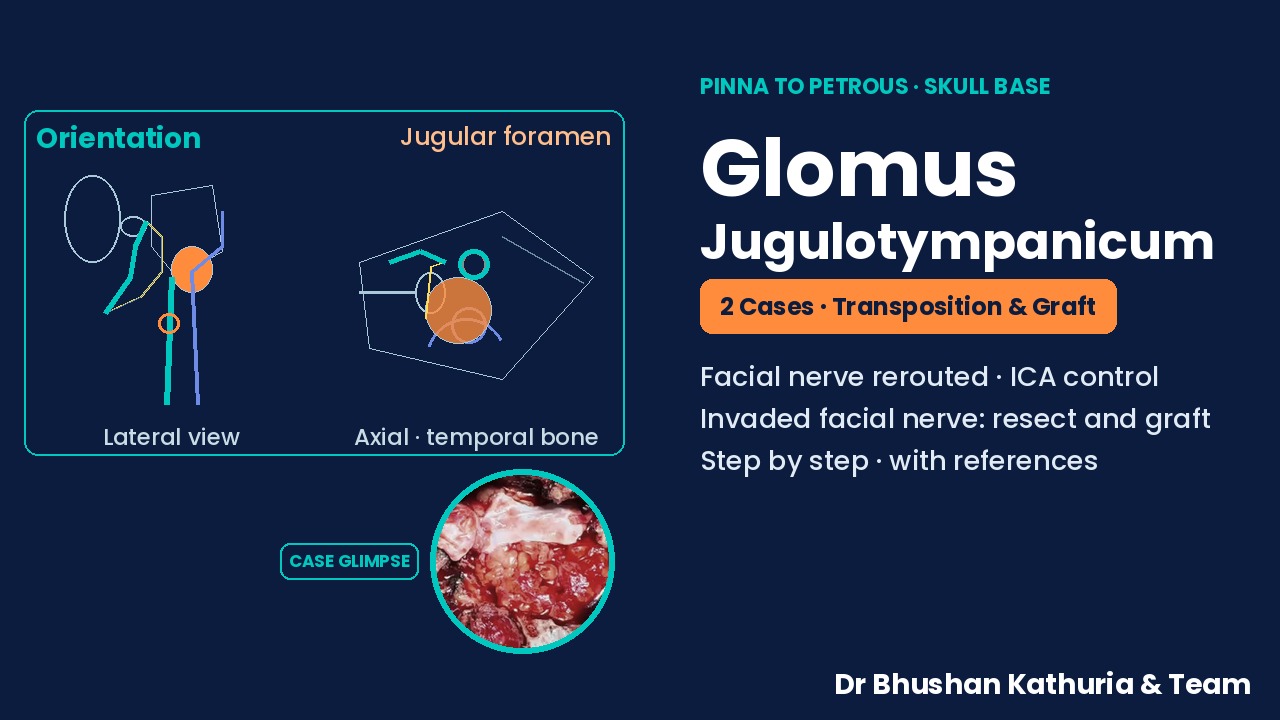
- Diagnosis
- Glomus jugulotympanicum (tympanojugular paraganglioma), two patients
- Approach
- Combined transmastoid and neck approach, pinna to petrous
- Case 1
- Anterior transposition of the facial nerve; intraoperative internal carotid artery control
- Case 2
- Facial nerve invaded by tumour: segment resected, interposition graft in the same sitting
- Video
- 3 min · 11 operative steps
Abstract
Two patients with glomus jugulotympanicum (tympanojugular paraganglioma) underwent excision through a combined transmastoid and neck approach, creating a single operative field from the pinna to the petrous bone. In both, the great vessels and lower cranial nerves were identified and controlled in the neck before work at the jugular foramen. In the first patient the facial nerve was transposed anteriorly for access to the jugular foramen, and the internal carotid artery was controlled intraoperatively. In the second, the facial nerve was involved by tumour; the involved segment was resected and reconstructed with an interposition graft in the same sitting. The operative steps are presented with geometric orientation, and the two strategies for the facial nerve are discussed.
Keywords: glomus jugulotympanicum; glomus jugulare; tympanojugular paraganglioma; jugular foramen; lateral skull base; infratemporal fossa approach; facial nerve rerouting; facial nerve transposition; internal carotid artery control; facial nerve graft; interposition graft
Introduction
Tympanojugular paragangliomas arise from paraganglia at the jugular bulb and middle ear and spread into the mastoid, the carotid canal, the lower cranial nerve foramina and, in advanced cases, the posterior fossa. Access to the jugular foramen and the intratemporal internal carotid artery is limited by the facial nerve; anterior rerouting of the nerve gives that exposure, at the cost of a usually temporary facial weakness [1]. When the tumour has invaded the nerve, preservation is not possible and resection with interposition grafting offers the best chance of useful facial function [2]. Lower cranial nerve outcomes depend strongly on intracranial extension, which favours timely surgery [3].
Case presentation
Case 1: glomus jugulotympanicum excised through a combined post-auricular transmastoid and cervical approach. The facial nerve was transposed anteriorly to expose the jugular foramen, and the internal carotid artery was controlled intraoperatively. Case 2: glomus jugulotympanicum with tumour involving the facial nerve; the involved segment was resected and an interposition graft placed in the same operation. Written informed consent for surgery and for de-identified educational use of images and video was obtained from both patients. Patient identity is not shown.
Surgical technique
Case 1 · Exposure
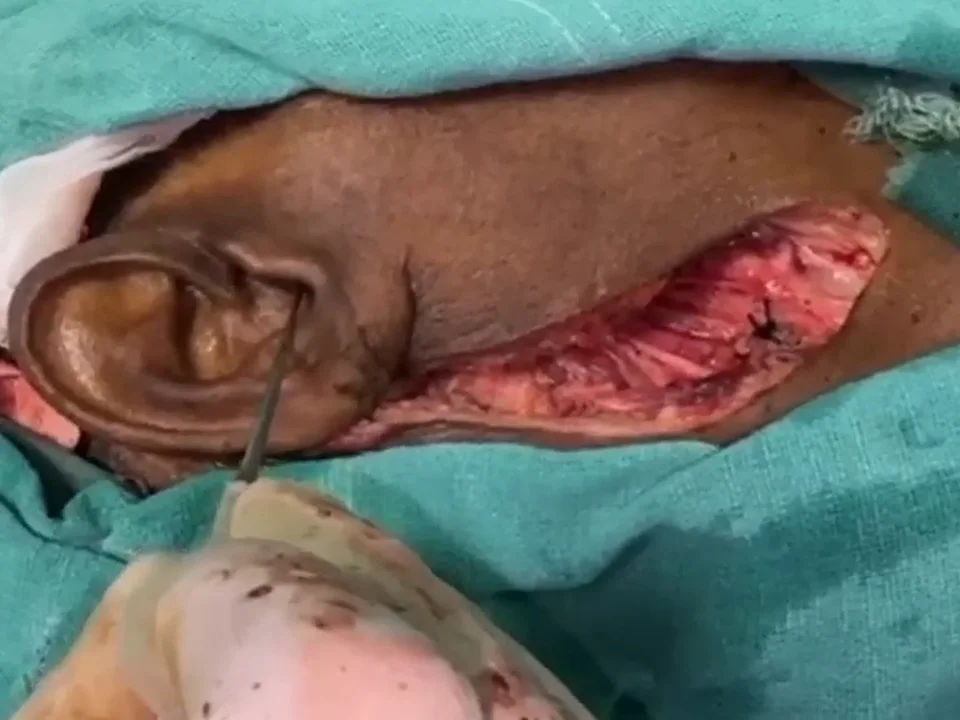
A post-auricular incision extended into the neck; the pinna is reflected so that the mastoid and neck are opened together.
Case 1 · Exposure Case 1 · Temporal bone and neck in continuity
One operative field extends from the pinna to the petrous bone.
Case 1 · Temporal bone and neck in continuity Case 1 · Neck control
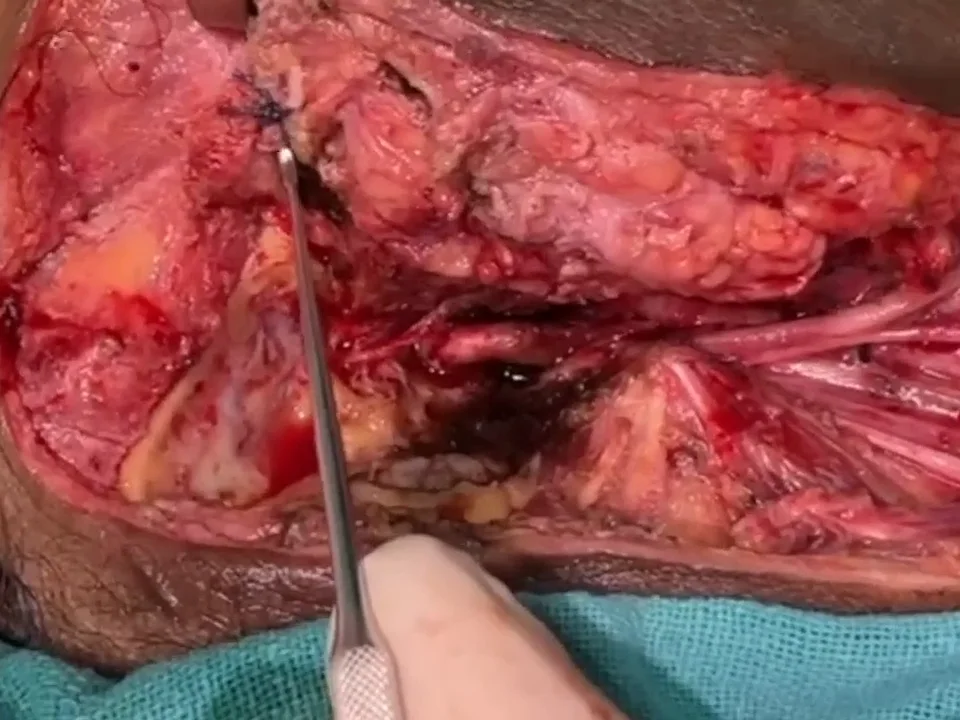
The great vessels and lower cranial nerves are identified and controlled in the neck before work at the skull base.
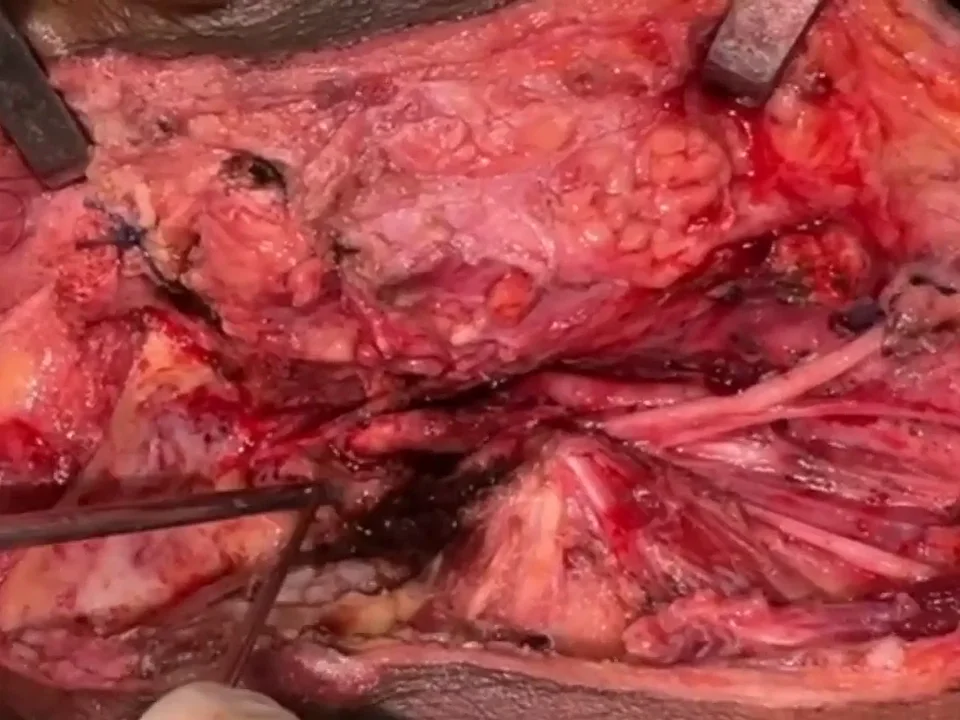
Case 1 · Neck control Case 1 · Jugular foramen region
The tumour bed after removal, with haemostasis secured.
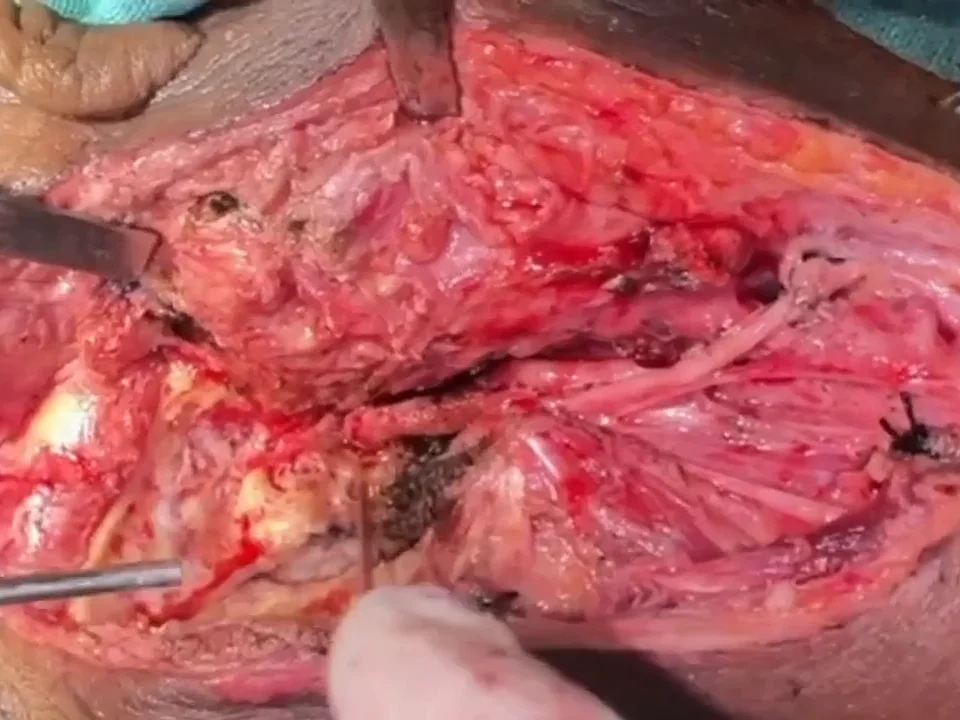
Case 1 · Jugular foramen region Case 1 · Facial nerve transposition
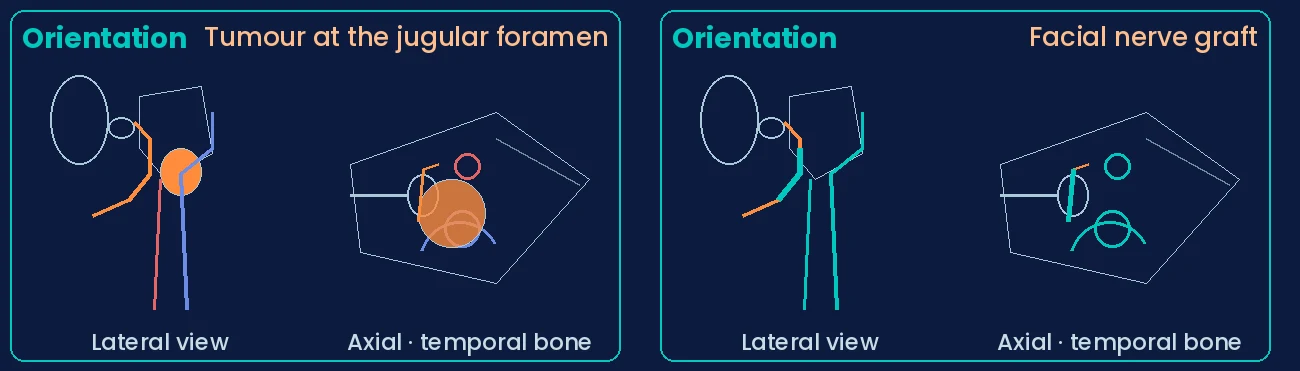
The facial nerve is rerouted anteriorly for access to the jugular foramen.
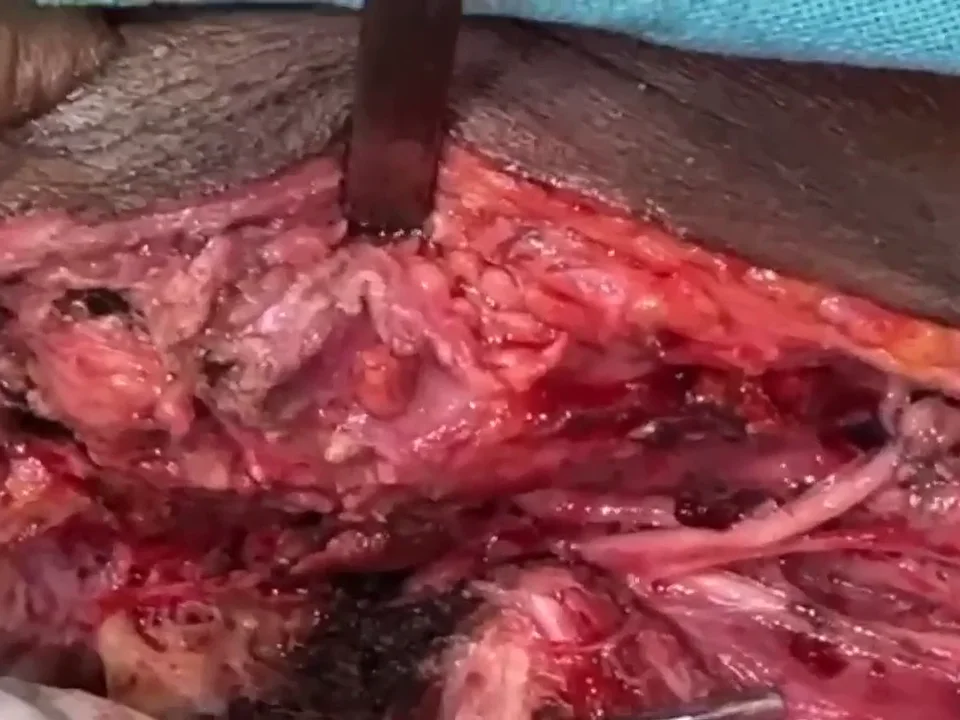
Case 1 · Facial nerve transposition Case 1 · Internal carotid artery control
The internal carotid artery is controlled intraoperatively at the skull base.
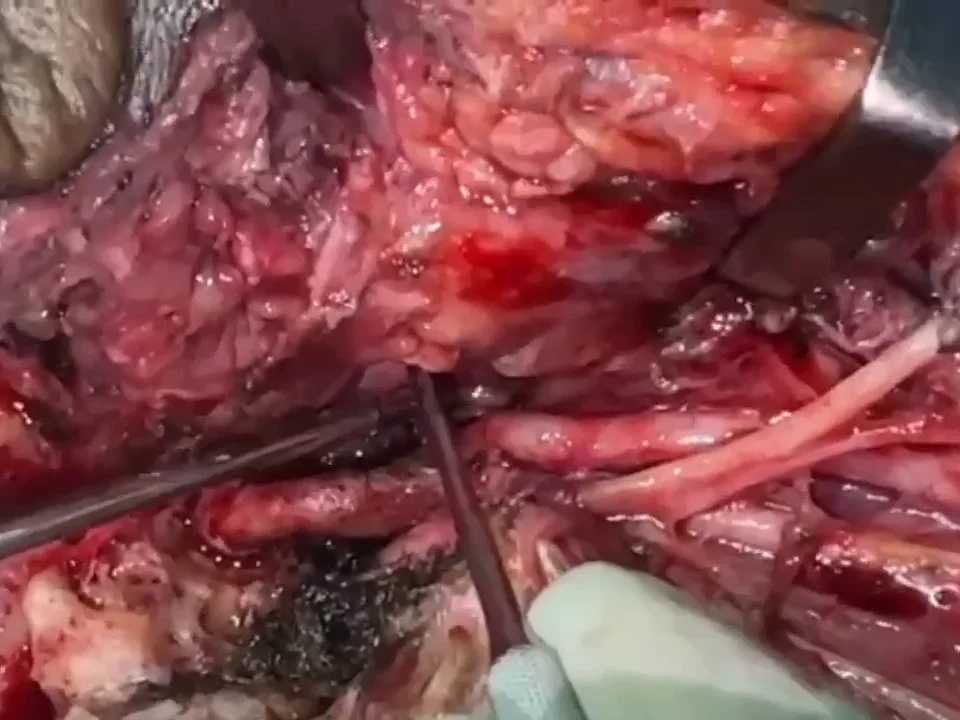
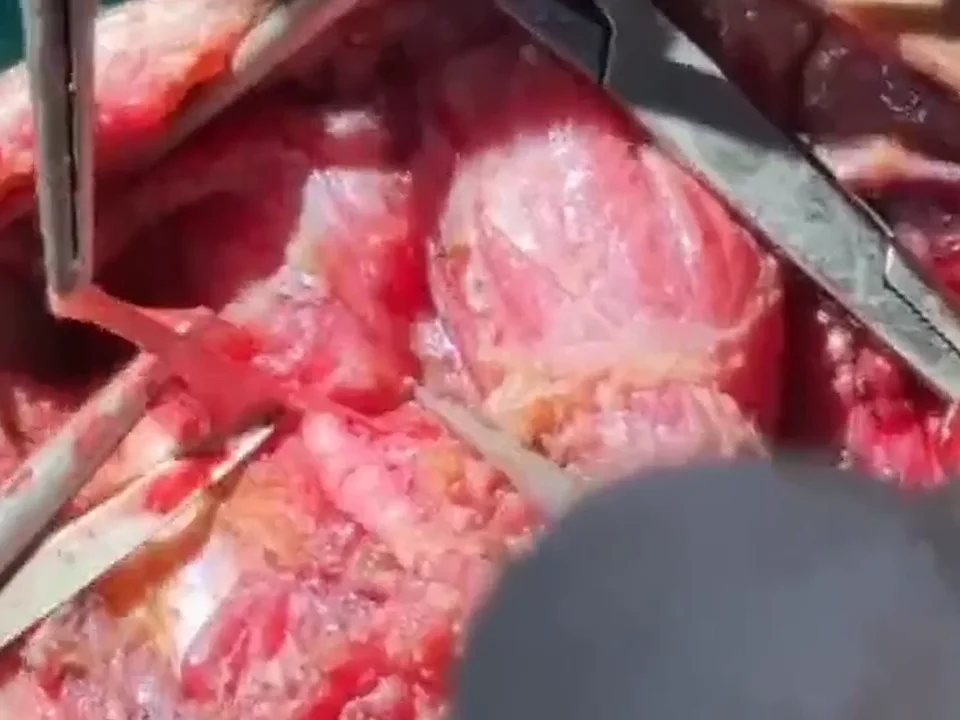
Case 1 · Internal carotid artery control Case 2 · Facial nerve graft
The facial nerve segment involved by tumour is resected and an interposition graft laid across the gap.
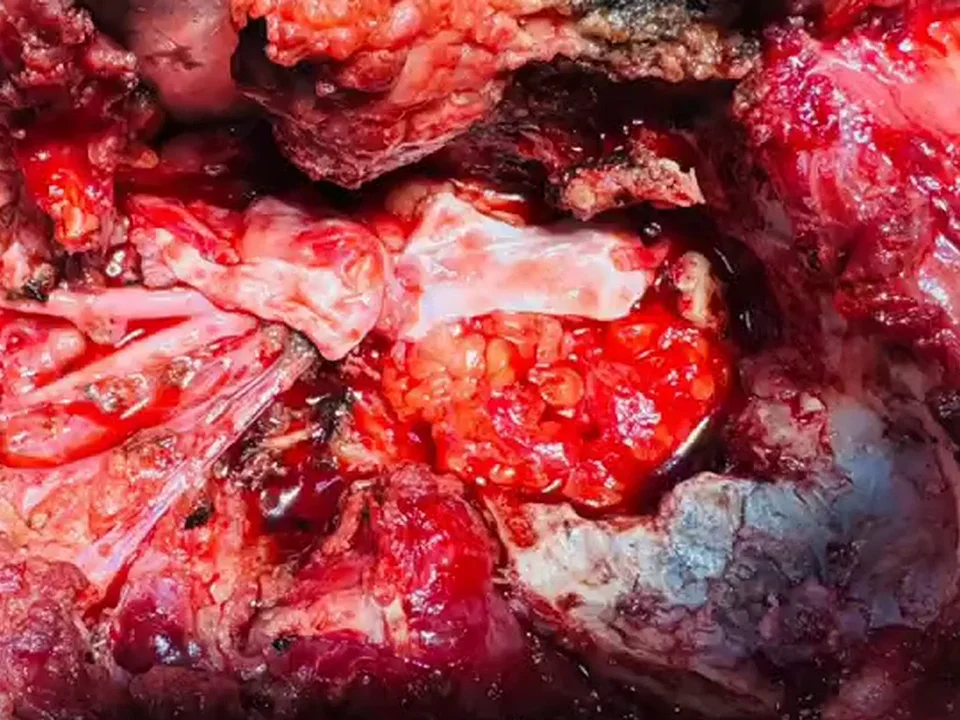
Case 2 · Facial nerve graft Case 2 · Graft in position
Facial nerve continuity is restored in the same sitting.
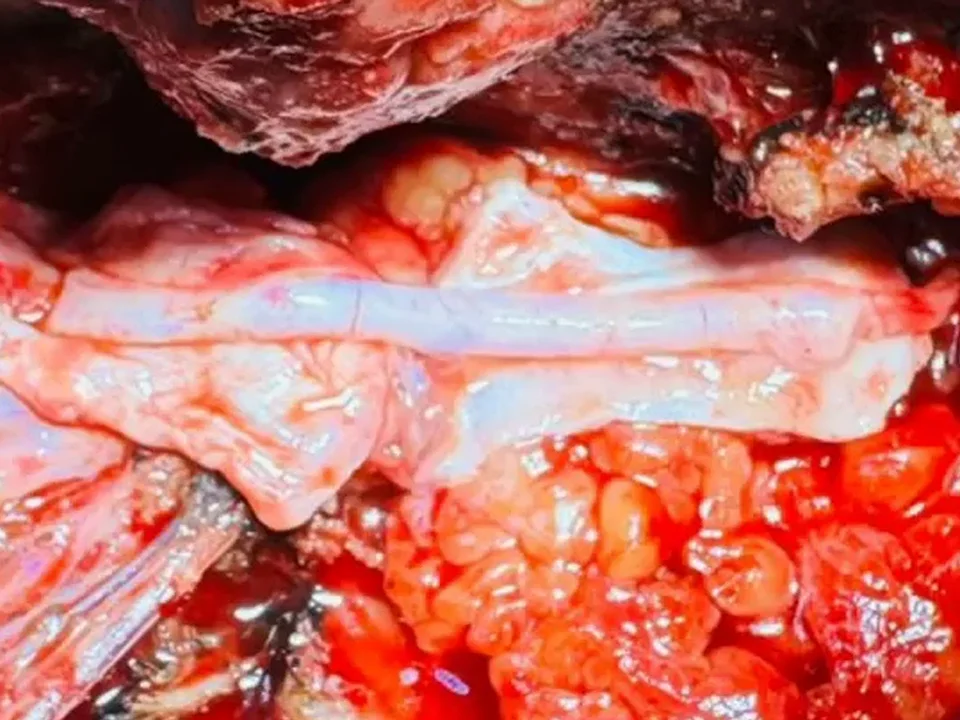
Case 2 · Graft in position Case 2 · Graft close-up
Tension-free coaptation at both ends before closure.
Case 2 · Graft close-up
Postoperative management
- Swallowing and voice assessed before oral feeding.
- Eye protection while facial function recovers.
- Facial function graded on the House-Brackmann scale at follow-up.
- Long-term imaging surveillance.
Discussion
The two cases show the two strategies for the facial nerve in jugular foramen surgery. When the nerve is free of tumour, anterior rerouting opens the jugular foramen, the infralabyrinthine area and the intratemporal carotid; in a series of 154 class C-D tumours removed this way, 94.8% had House-Brackmann grade I-III facial function at last follow-up [1]. When the vertical segment is invaded, the nerve cannot be preserved; resection with interposition grafting achieved grade III in eight of nine patients in one series [2]. In both strategies, control of the internal jugular vein, carotid arteries and lower cranial nerves in the neck before opening the jugular foramen allows the tumour to be followed from known anatomy below into the temporal bone above [3].
Learning points
- Control the great vessels and lower cranial nerves in the neck before working at the jugular foramen.
- A tumour-free facial nerve can be transposed anteriorly for access to the jugular foramen and carotid.
- If the facial nerve is invaded, resect and graft in the same sitting.
References
- Sun Y, Fancello G, Yilala MH, et al. Facial nerve outcomes after infratemporal fossa approach type A with anterior rerouting for class C-D tympanojugular paragangliomas removal: analysis from a quaternary referral center. Otol Neurotol. 2026;47(2):343-349. https://doi.org/10.1097/MAO.0000000000004743
- Leonetti JP, Anderson DE, Marzo SJ, et al. Facial paralysis associated with glomus jugulare tumors. Otol Neurotol. 2007;28(1):104-106. https://doi.org/10.1097/01.mao.0000244357.72626.f5
- Grinblat G, Sanna M, Piccirillo E, et al. Comparison of lower cranial nerve function between tympanojugular paraganglioma class C1/C2 with and without intracranial extension: a four-decade experience. Otol Neurotol. 2022;43(1):e122-e130. https://doi.org/10.1097/MAO.0000000000003383
Consent and ethics
Written informed consent was obtained for surgery and for de-identified use of clinical images and video for education. No identifying information is shown; eyes are blurred where visible. This report is for medical education and does not replace individual clinical advice.
Surgical team
Dr Bhushan Kathuria & Team, Santosh Advance ENT Healthcare, Hisar. Consultants: Dr Bhushan Kathuria, Dr Parmod Jangra, Dr Harshvardhan. Clinical fellows: Dr Ayush, Dr Iqrorjon. Team · Fellowship and previous fellows.
How to cite
Kathuria B, and Team. Glomus Jugulotympanicum, Two Cases from Pinna to Petrous: Facial Nerve Transposition with Carotid Control, and Facial Nerve Resection with Interposition Grafting. Surgical Perspective · Surgical Case Reports. 2026. Available at: https://bhushankathuria.com/case-glomus-jugulotympanicum-lateral-skull-base-facial-nerve-graft.html
More case reports
Extended Total Maxillectomy with Infratemporal Fossa, Transpterygoid and Anterior Skull Base Clearance for Sinonasal Mucormycosis
Upfront radical resection for fulminant sinonasal mucormycosis
▶ Video + case report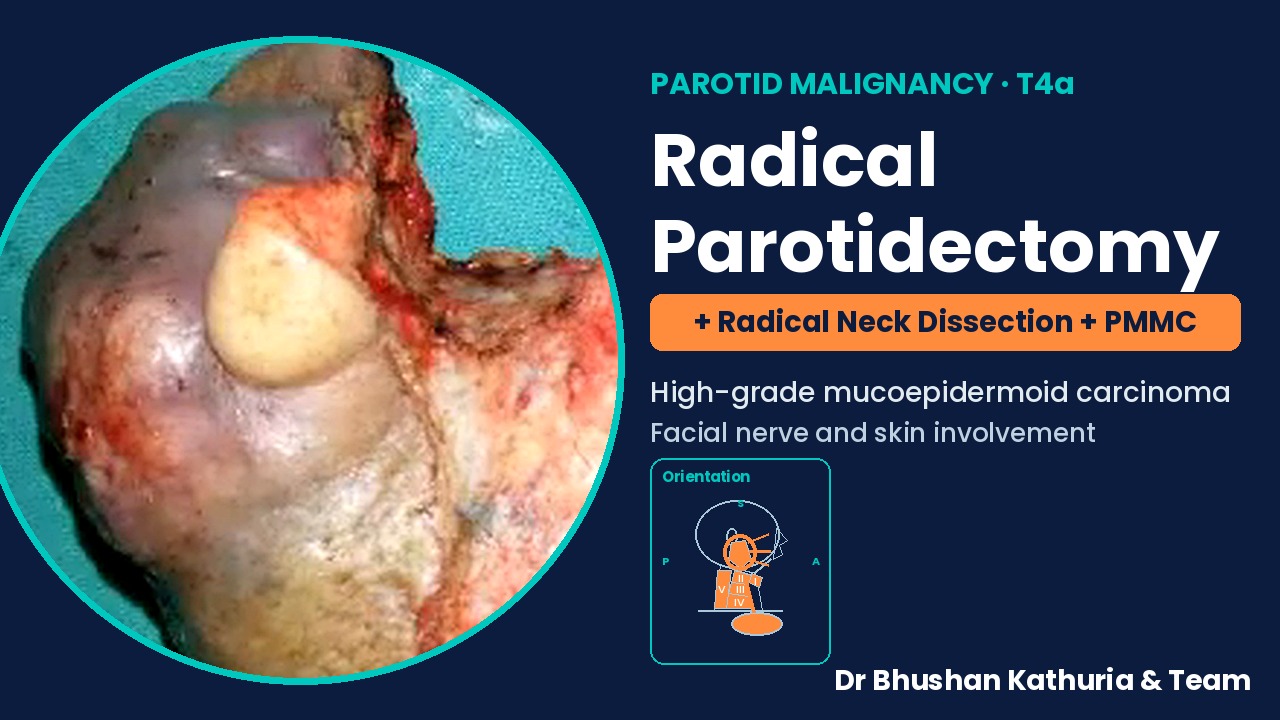
High-Grade Mucoepidermoid Carcinoma of the Parotid with Facial Nerve and Skin Involvement: Radical Parotidectomy, Radical Neck Dissection and PMMC Flap Reconstruction
Composite parotid resection with single-stage PMMC reconstruction
▶ Video + case report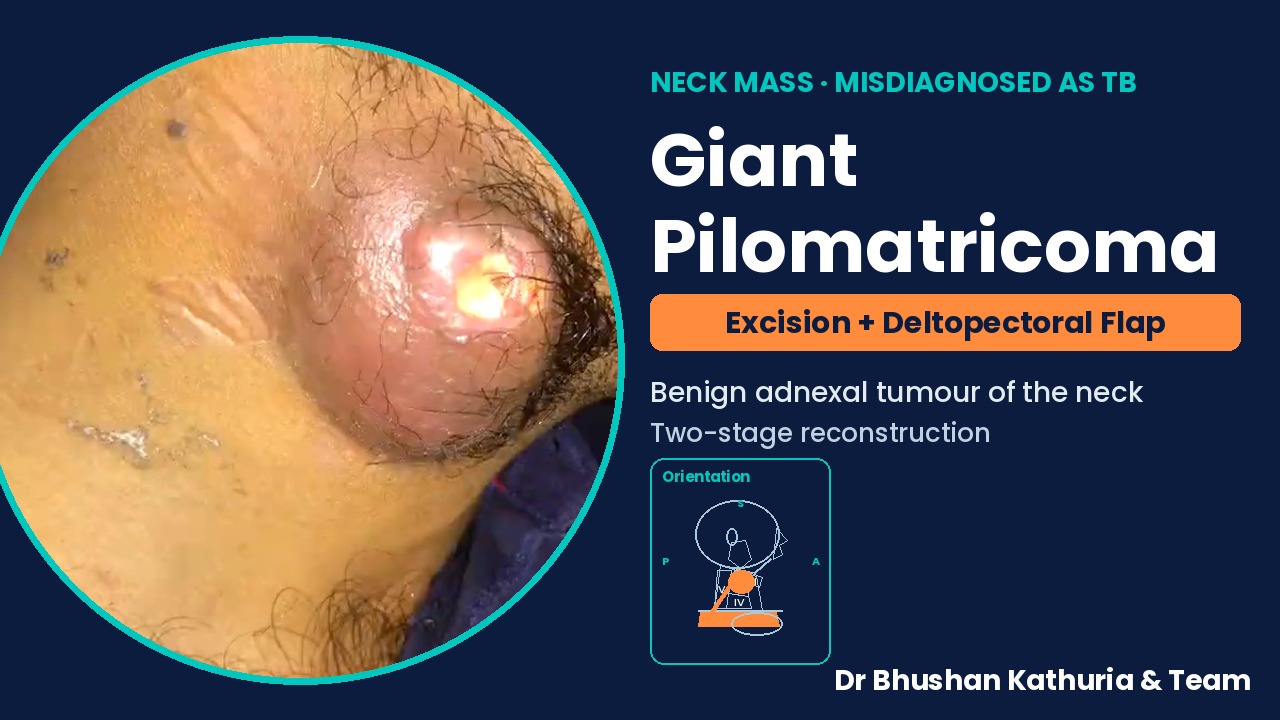
Giant Pilomatricoma of the Neck Misdiagnosed as Tubercular Lymphadenitis: Wide Local Excision and Two-Stage Deltopectoral Flap Reconstruction
Pilomatricoma presenting as a non-healing neck mass
▶ Video + case report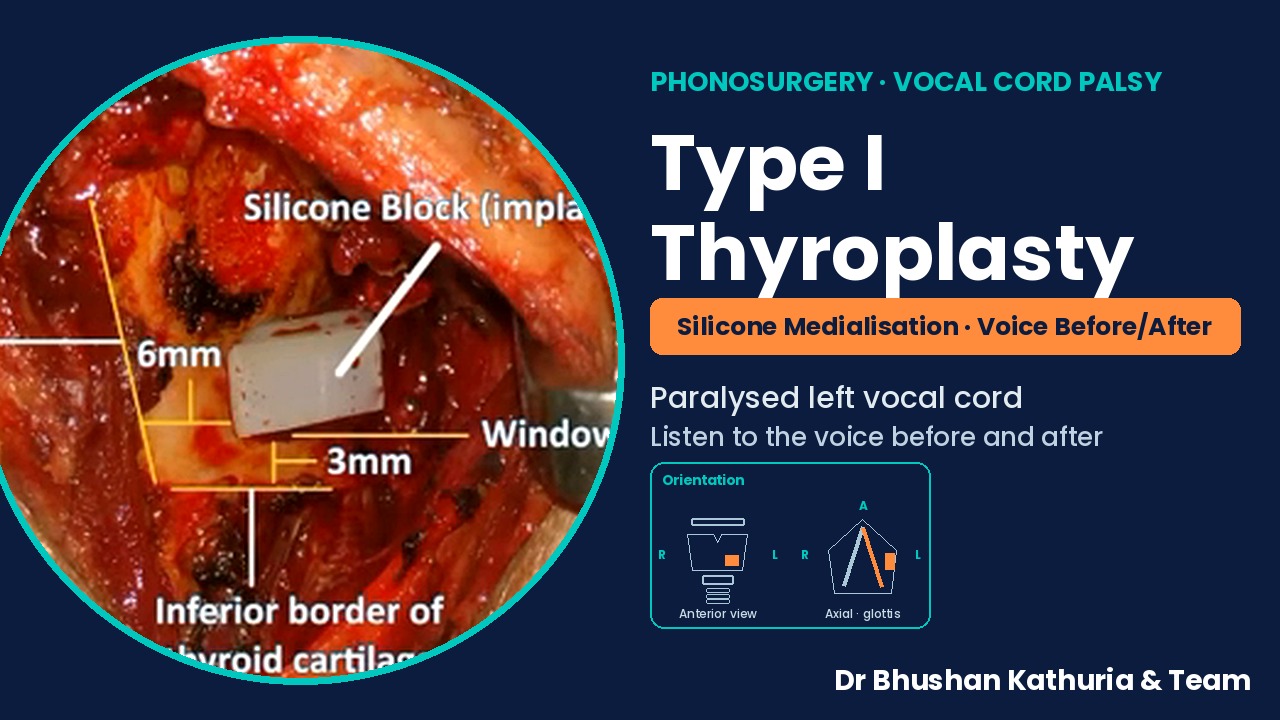
Type I Thyroplasty: Silicone Medialisation of a Paralysed Left Vocal Cord, with Pre- and Post-operative Voice
Medialisation thyroplasty for unilateral vocal fold palsy
▶ Video + case report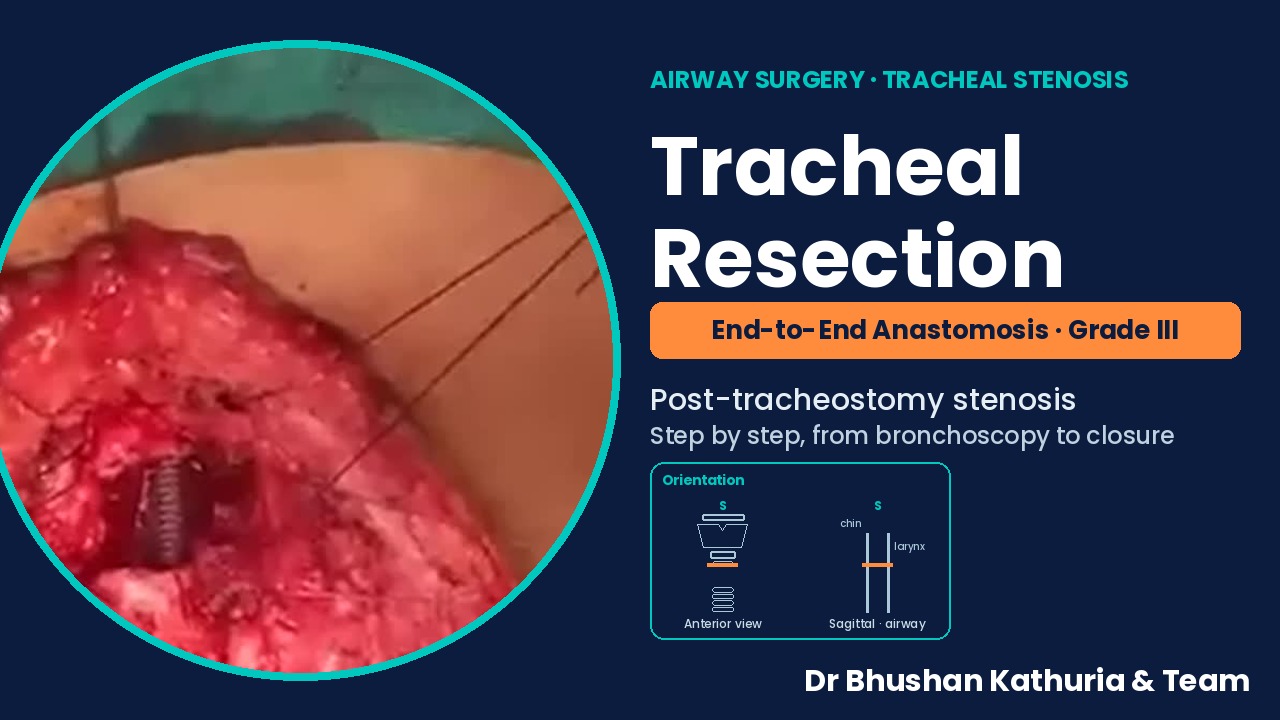
Segmental Tracheal Resection and End-to-End Anastomosis for Grade III Post-tracheostomy Tracheal Stenosis
Tracheal resection and primary anastomosis after failed decannulation
▶ Video + case report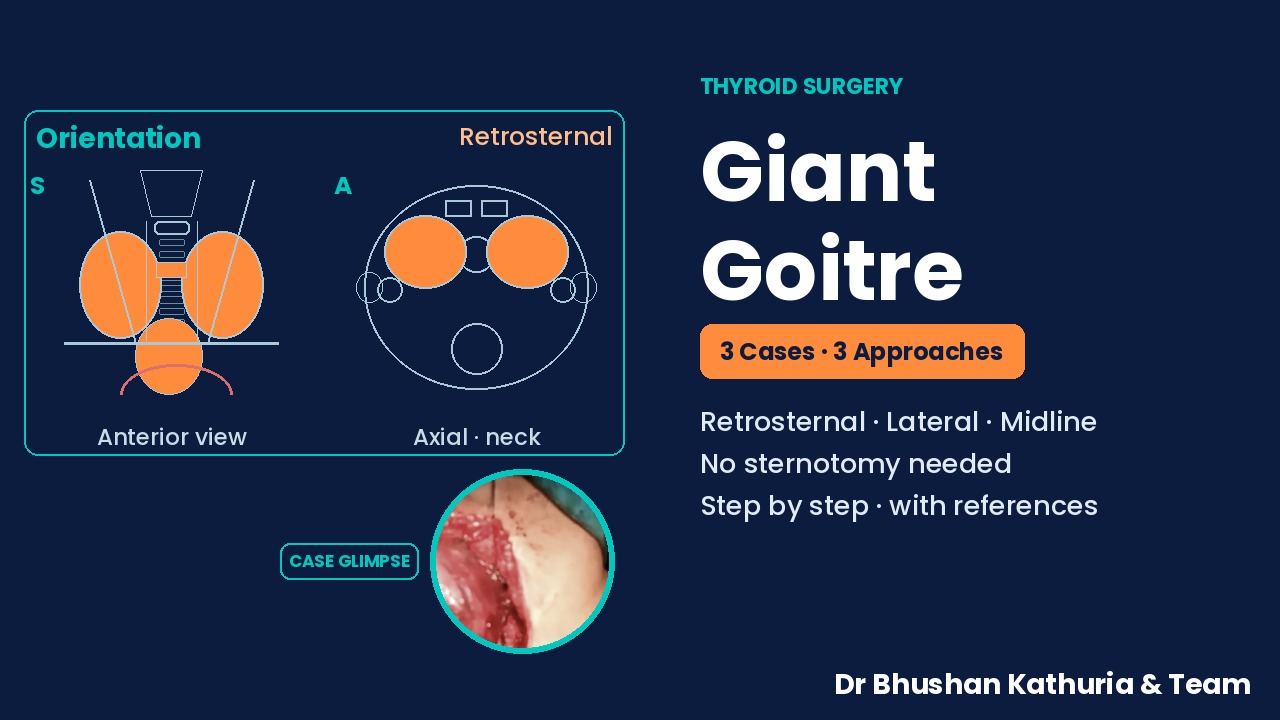
Giant Goitre: Three Cases and Three Approaches — Cervical Delivery of Retrosternal Extension, Lateral Strap-Sparing and Midline Strap-Dividing Thyroidectomy
Three giant goitres, three surgical approaches
Case reportAll surgical case reports → · Skull Base · Eardrum Perforation · Videos · YouTube channel · WhatsApp channel