
Persistent hoarseness, swallowing difficulty or a neck lump deserves assessment.
आवाज़ बैठना, निगलने में दिक्कत या सांस में आवाज़ — जांच कराएं।Awaaz 3 hafte se zyada baithi hai? Gale ke cancer ke lakshan pehchanein.
Most throat symptoms are not cancer. But symptoms that persist, progress or remain unexplained should not simply be ignored—particularly when voice, swallowing, breathing or the neck is involved.
 In this guide
The exact site matters.
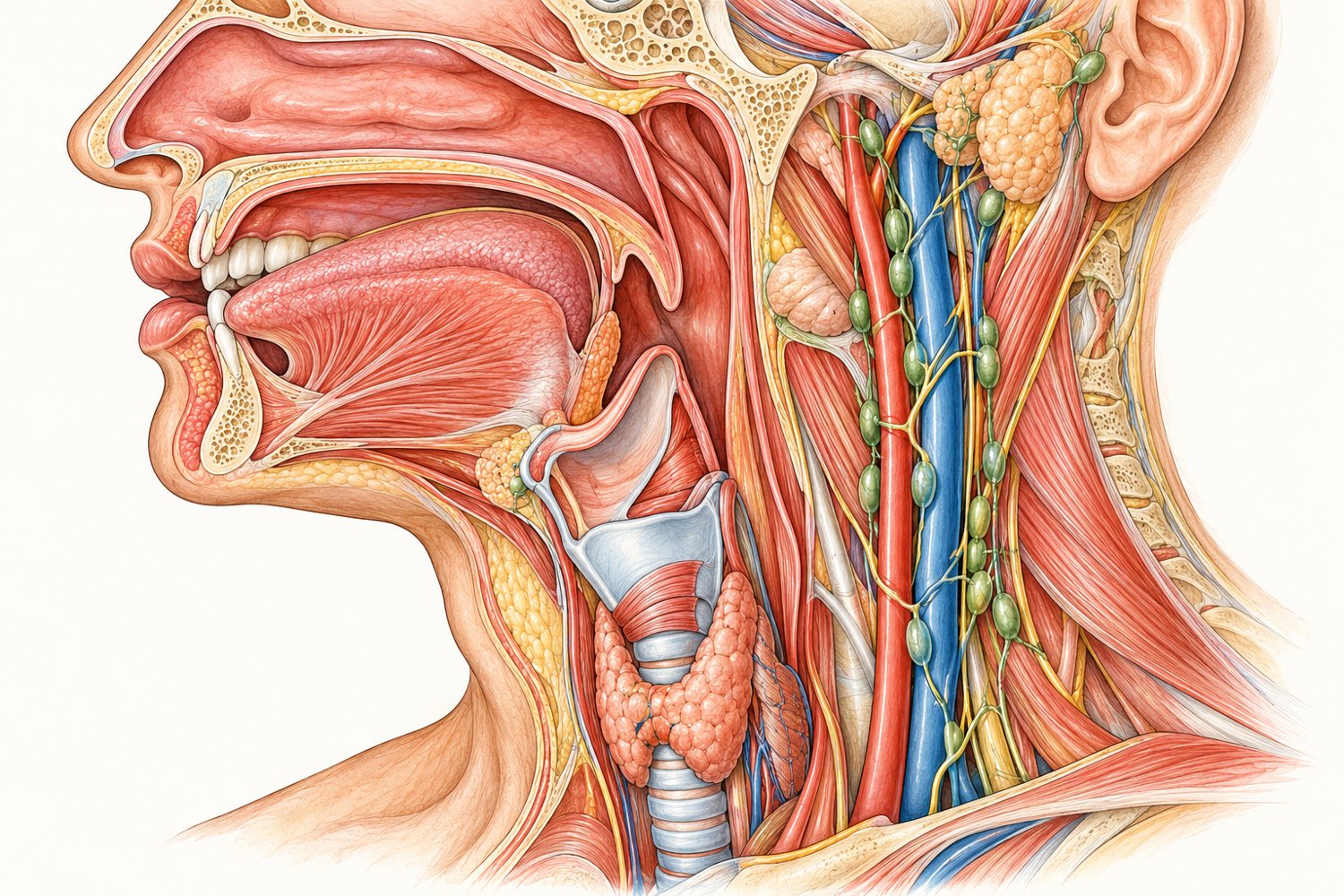
“Throat cancer” is a broad public term. Tumours can arise in different parts of the upper airway and swallowing passage, including the larynx (voice box) and hypopharynx. The exact site, tissue diagnosis and stage determine treatment options.
The larynx is important for voice, airway protection during swallowing and breathing. This is why treatment planning considers not only cancer control but also function.
Symptoms worth checking
Persistent hoarseness or voice change, a new or enlarging neck lump, pain or difficulty on swallowing, persistent throat discomfort, unexplained ear pain, coughing blood, unexplained weight loss, noisy breathing or breathlessness can require specialist assessment.
Diagnosis is a sequence—not a guess from symptoms.
- History & examinationSymptoms, duration, tobacco/alcohol exposure, prior treatment and neck examination help define the problem.
- Flexible endoscopyA thin camera may be used to inspect the nose, throat, larynx and vocal cords in clinic.
- ImagingCT, MRI, ultrasound or other imaging may be selected depending on the suspected site and findings.
- Tissue diagnosisSuspicious lesions generally require biopsy. A neck node may sometimes be sampled with a needle.
- Stage & planOnce diagnosis and extent are known, the multidisciplinary team can discuss appropriate treatment options.
There is no single treatment for every throat cancer.
Treatment may involve surgery, radiotherapy, systemic treatment, or a combination. Choice depends on the exact site, stage, pathology, overall health, prior treatment and expected effects on speech, swallowing and breathing.
Early laryngeal cancers may sometimes be treated with organ-preserving approaches such as endoscopic surgery or radiotherapy. More advanced disease can require more complex multimodality treatment.
Questions to ask
Where exactly is the tumour? What is the biopsy diagnosis and stage? What alternatives exist? How might treatment affect voice, swallowing and breathing? Will dental, nutrition, speech/swallowing or rehabilitation support be needed?
Breathing difficulty is different from routine hoarseness.
Progressive noisy breathing, significant breathlessness, choking, inability to speak normally because of breathing difficulty, rapidly increasing neck swelling or significant bleeding requires urgent in-person assessment. Severe breathing difficulty is an emergency.
Symptoms do not equal cancer
Reflux, infection, benign vocal-cord lesions and many other conditions can cause similar symptoms. The purpose of timely ENT assessment is to identify the cause—not to assume the worst.
Medical information notice: This page provides general education and cannot diagnose cancer or recommend an individual treatment plan. Persistent or concerning symptoms require clinical assessment. Treatment decisions should be based on examination, endoscopy, pathology, imaging and multidisciplinary review where appropriate.
आवाज़, निगलने और सांस की तकलीफ़ — आम सवाल
आवाज़ कितने दिन बैठी रहे तो जांच कराएं?
तीन हफ्ते से ज़्यादा आवाज़ बैठी रहे तो ENT डॉक्टर से गले की दूरबीन जांच कराएं। सांस लेने में आवाज़ या तकलीफ़ हो तो तुरंत दिखाएं।
हिसार में आवाज़, निगलने और सांस की तकलीफ़ का इलाज कहाँ होता है?
संतोष एडवांस ईएनटी हेल्थकेयर, मंगलम लैब के पास, दयानंद कॉलोनी, जिंदल हॉस्पिटल रोड, मॉडल टाउन, हिसार (हरियाणा) 125001 में डॉ भूषण कथूरिया और ENT टीम आवाज़, निगलने और सांस की तकलीफ़ की जांच और इलाज करती है। OPD सोमवार से शनिवार, सुबह 10 से शाम 5 बजे; इमरजेंसी के लिए ENT सेवाएं 24 घंटे। फोन / WhatsApp: 85291 66866 / 70156 71278।
क्या आयुष्मान कार्ड या बीमा से इलाज हो सकता है?
हाँ, आयुष्मान भारत और सभी TPA बीमा में कैशलेस इलाज की सुविधा है — पात्रता, योजना के नियम और मंज़ूरी के अनुसार। ऑपरेशन या भर्ती से पहले केयर डेस्क से पुष्टि करें।
More patient guides
Aur jaankari, aasaan bhasha mein.
Have these symptoms?
Yeh lakshan hain? ENT jaanch karayein.
Book a consultation — bring any scans or reports you already have.