Thyroid nodule & thyroid cancer.
गले में थायरॉइड की गांठ? ज़्यादातर कैंसर नहीं होती, पर सही जांच ज़रूरी है।Thyroid ki gaanth har baar cancer nahi hoti — sahi jaanch zaroori hai.
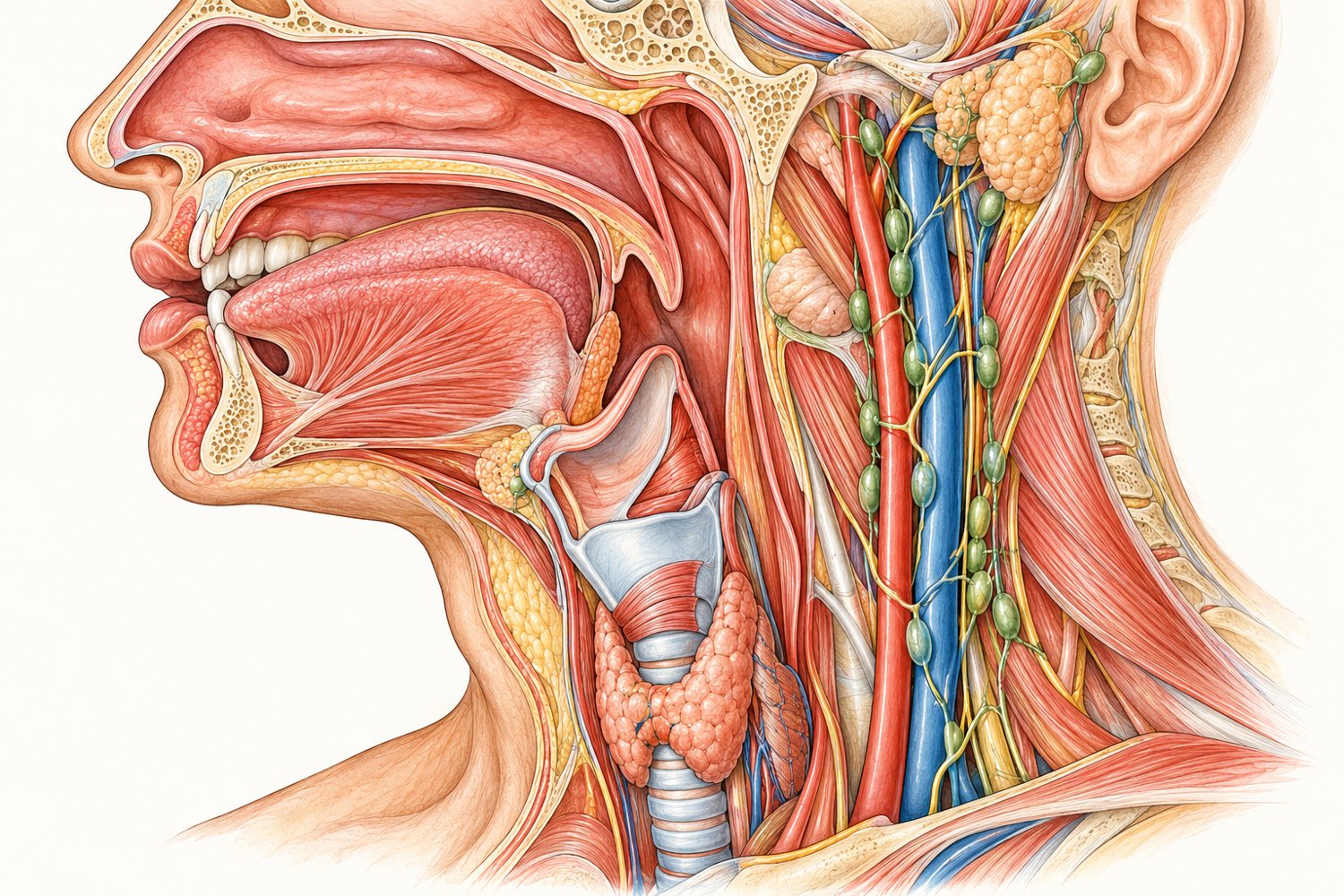
A thyroid lump is common and most nodules are not cancer. The important step is structured assessment: clinical examination, thyroid function testing, high-quality ultrasound and fine-needle aspiration when indicated.
 In this guide
A thyroid nodule is not the same as thyroid cancer.
Many thyroid nodules are discovered incidentally and cause no symptoms. Blood thyroid tests may also be normal even when a nodule needs further assessment. Evaluation is therefore based on the complete clinical picture rather than a single blood test or scan finding.
Symptoms that deserve assessment include a new or enlarging lower-neck lump, pressure or swallowing difficulty, unexplained voice change, or associated neck lymph-node swelling.
What the first assessment may include
History and neck examination, thyroid-stimulating hormone (TSH) testing, thyroid and neck ultrasound, review of prior imaging, and—when the ultrasound pattern and size justify it—ultrasound-guided fine-needle aspiration (FNA).
How a thyroid nodule is usually evaluated.
- Clinical reviewAssess the thyroid, neck nodes, symptoms, prior radiation or surgery and relevant family history.
- UltrasoundDefines nodule size and composition and looks for ultrasound features that influence whether biopsy or surveillance is appropriate.
- FNA when indicatedA thin needle obtains cells for cytology. Not every thyroid nodule requires biopsy.
- Interpret the resultCytology may be benign, indeterminate, suspicious, malignant or occasionally non-diagnostic. The next step depends on the category and ultrasound context.
- Plan careOptions may include surveillance, repeat assessment, additional testing or surgery.
What does an FNA result mean?
FNA is usually performed under ultrasound guidance. It samples cells rather than removing the entire nodule. A benign result commonly leads to clinical and ultrasound follow-up rather than immediate surgery. An indeterminate or non-diagnostic result may require repeat FNA, additional assessment or surgery depending on the individual situation.
A suspicious or malignant result requires specialist discussion of treatment. Final diagnosis and tumour details may depend on the surgical pathology specimen.
Do not interpret cytology alone
The biopsy category should be considered together with ultrasound findings, nodule size, symptoms, lymph-node findings and the patient's circumstances. A report copied from another centre is most useful when the ultrasound images and cytology/pathology report are also available.
Treatment is risk-adapted, not identical for every patient.
Surgery is a central treatment for many thyroid cancers. Depending on tumour type, size, location and spread, surgery may involve removal of one thyroid lobe or the whole thyroid, with lymph-node surgery when clinically indicated.
Selected differentiated thyroid cancers may also require radioactive iodine after surgery. Thyroid hormone replacement and longer-term surveillance may form part of follow-up. Advanced or uncommon thyroid cancers can require different multidisciplinary treatment strategies.
Questions worth discussing before surgery
What is the biopsy diagnosis? Is one lobe or the whole thyroid being considered? Are any lymph nodes suspicious? What are the expected voice, calcium and thyroid-hormone implications? Is radioactive iodine likely to be considered afterward?
Voice assessment matters in thyroid surgery.
The nerves controlling the vocal cords run close to the thyroid. Pre-existing hoarseness or voice change should therefore be reported before surgery and may require laryngeal examination. Postoperative voice change should also be assessed appropriately rather than assumed to be routine.
Seek urgent care
Rapidly increasing neck swelling with breathing difficulty, significant airway symptoms or rapidly worsening compression requires urgent in-person assessment. Do not wait for a routine online appointment.
थायरॉइड की गांठ — आम सवाल
गले में थायरॉइड की गांठ हो तो क्या वह कैंसर है?
ज़्यादातर थायरॉइड गांठें कैंसर नहीं होतीं। खून की जांच, गले का अल्ट्रासाउंड और FNAC (सुई जांच) से तय होता है कि दवा, निगरानी या ऑपरेशन चाहिए। ऑपरेशन में आवाज़ की नसों को बचाया जाता है।
हिसार में थायरॉइड की गांठ का इलाज कहाँ होता है?
संतोष एडवांस ईएनटी हेल्थकेयर, मंगलम लैब के पास, दयानंद कॉलोनी, जिंदल हॉस्पिटल रोड, मॉडल टाउन, हिसार (हरियाणा) 125001 में डॉ भूषण कथूरिया और ENT टीम थायरॉइड की गांठ की जांच और इलाज करती है। OPD सोमवार से शनिवार, सुबह 10 से शाम 5 बजे; इमरजेंसी के लिए ENT सेवाएं 24 घंटे। फोन / WhatsApp: 85291 66866 / 70156 71278।
क्या आयुष्मान कार्ड या बीमा से इलाज हो सकता है?
हाँ, आयुष्मान भारत और सभी TPA बीमा में कैशलेस इलाज की सुविधा है — पात्रता, योजना के नियम और मंज़ूरी के अनुसार। ऑपरेशन या भर्ती से पहले केयर डेस्क से पुष्टि करें।
More patient guides
Aur jaankari, aasaan bhasha mein.
Have these symptoms?
Yeh lakshan hain? ENT jaanch karayein.
Book a consultation — bring any scans or reports you already have.