
Cochlear implant: a pathway, not just an operation.
कॉक्लियर इम्प्लांट — जांच से लेकर सुनना और बोलना सीखने तक।Cochlear implant — jaanch se lekar sunna aur bolna seekhne tak.
A cochlear implant can provide access to sound for selected children and adults with significant hearing loss when conventional amplification is not providing enough benefit. Assessment, surgery, programming and rehabilitation all contribute to outcome.
 In this guide
How is a cochlear implant different from a hearing aid?
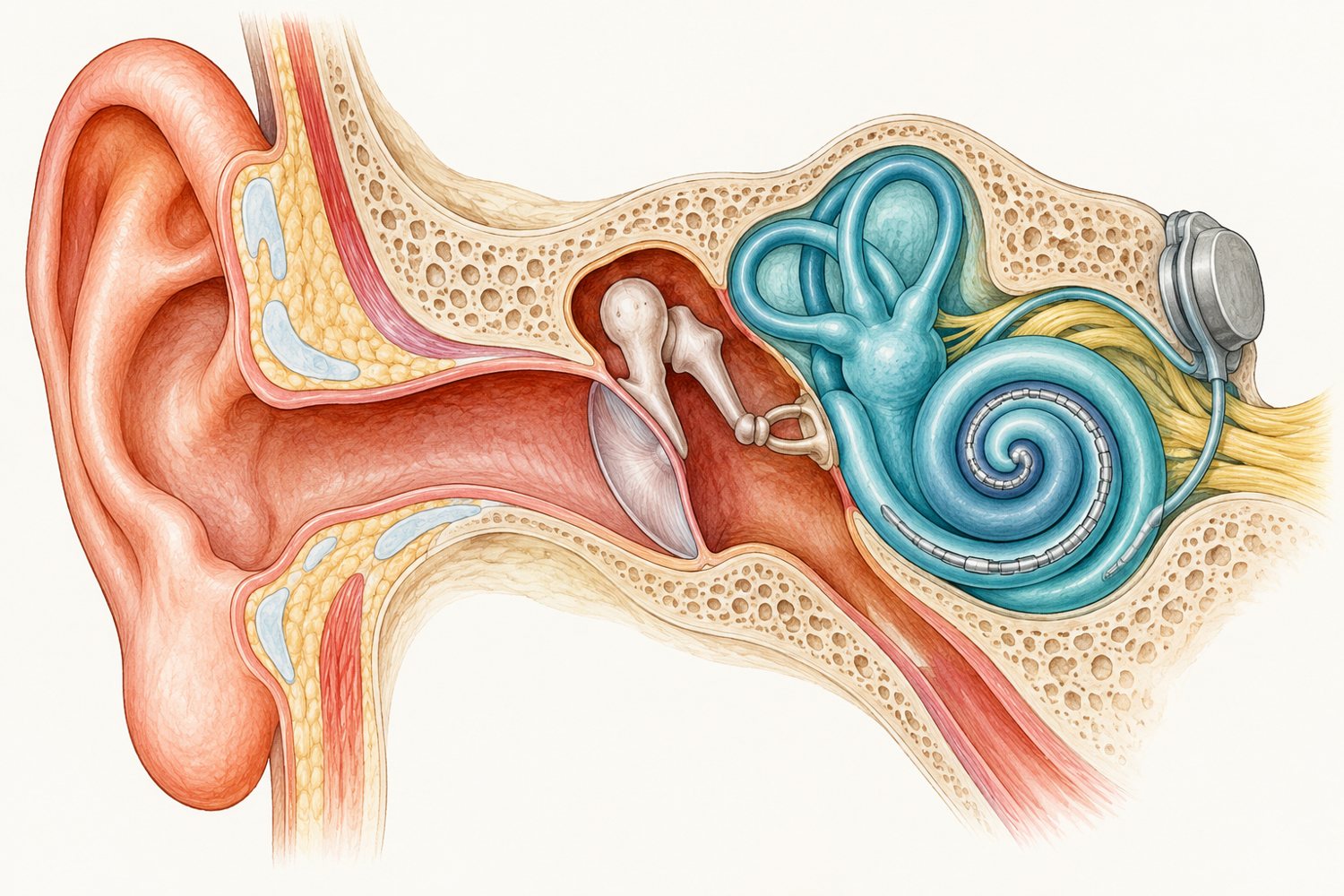
A hearing aid mainly amplifies sound. A cochlear implant uses an implanted electrode system to bypass damaged inner-ear sensory structures and electrically stimulate the auditory nerve. It does not restore normal hearing; the brain must learn to interpret the new electrical sound signal.
For that reason, implantation should be viewed as one part of a longer hearing-rehabilitation programme.
Who may be assessed?
Children or adults with severe or profound hearing difficulty, poor speech understanding despite appropriately fitted hearing aids, or selected patterns of asymmetric/single-sided hearing loss may be considered for formal cochlear-implant assessment. Candidacy is individual and depends on audiological, medical and communication factors.
A structured assessment comes first.
- Hearing historyOnset and duration of hearing loss, hearing-aid use, communication needs and previous ear disease are reviewed.
- AudiologyPure-tone testing, speech perception and aided performance help establish how much useful benefit current hearing technology provides.
- ENT assessmentThe ears, hearing-loss cause, previous surgery and medical fitness for implantation are evaluated.
- ImagingCT and/or MRI may be used when appropriate to assess cochlear anatomy, the auditory pathway and surgical considerations.
- CounsellingExpected benefit, limitations, device use, surgery and the commitment required for programming and rehabilitation are discussed.
What happens during implantation?
The internal receiver is positioned beneath the skin and an electrode array is inserted into the cochlea. Surgical planning aims for safe placement while respecting the anatomy of the facial nerve, middle ear and inner ear.
As with any operation, risks and alternatives should be discussed individually. These may include infection, dizziness, taste disturbance, facial-nerve injury, changes in residual hearing, device-related problems and anaesthetic risks, although the exact risk profile varies between patients.
The external processor comes later
The implant is not normally used immediately after surgery. After initial healing, the external sound processor is fitted and the implant is activated/programmed by the audiology team according to the centre's protocol.
Mapping and rehabilitation are essential.
At activation, sound may initially seem unfamiliar. Audiologists progressively programme or “map” the implant, and repeated follow-up is usually required as listening responses develop.
Children commonly need structured auditory and language habilitation. Adults may need auditory rehabilitation to associate the implant signal with speech and environmental sounds. Progress varies considerably between individuals.
Outcome is not identical for everyone
Age at implantation, duration and cause of hearing loss, auditory-nerve function, previous hearing-aid use, language exposure, consistent processor use and participation in rehabilitation can all influence outcome. A cochlear implant should therefore not be presented as an instant or guaranteed restoration of normal hearing.
The pathway continues after the first year.
Programming
Periodic audiology review helps optimise processor settings and monitor hearing performance.
Device care
Families and users learn processor handling, batteries/charging, accessories and troubleshooting.
Rehabilitation
Listening, speech and language goals are reviewed over time according to age and communication needs.
Medical follow-up
New ear symptoms, wound problems, significant dizziness or device concerns should be discussed with the implant team.
Individual assessment determines candidacy.
Device indications and candidacy criteria vary by age, hearing pattern, regulatory approval and implant programme. This page provides general education and cannot determine whether a particular patient should receive a cochlear implant.
Need urgent assessment?
Sudden new hearing loss should not be treated as a routine cochlear-implant enquiry. Sudden sensorineural hearing loss requires prompt medical assessment because early treatment may be important.
Back to Patient Educationकॉक्लियर इम्प्लांट — आम सवाल
कॉक्लियर इम्प्लांट किसके लिए है?
जिन्हें मशीन से भी ठीक से सुनाई नहीं देता (बहुत ज़्यादा सुनने की कमी), उनके लिए कॉक्लियर इम्प्लांट हो सकता है। बच्चों में जितना जल्दी हो, बोलना सीखने में उतना फायदा। ऑपरेशन के बाद स्पीच थेरेपी ज़रूरी है।
हिसार में कॉक्लियर इम्प्लांट का इलाज कहाँ होता है?
संतोष एडवांस ईएनटी हेल्थकेयर, मंगलम लैब के पास, दयानंद कॉलोनी, जिंदल हॉस्पिटल रोड, मॉडल टाउन, हिसार (हरियाणा) 125001 में डॉ भूषण कथूरिया और ENT टीम कॉक्लियर इम्प्लांट की जांच और इलाज करती है। OPD सोमवार से शनिवार, सुबह 10 से शाम 5 बजे; इमरजेंसी के लिए ENT सेवाएं 24 घंटे। फोन / WhatsApp: 85291 66866 / 70156 71278।
क्या आयुष्मान कार्ड या बीमा से इलाज हो सकता है?
हाँ, आयुष्मान भारत और सभी TPA बीमा में कैशलेस इलाज की सुविधा है — पात्रता, योजना के नियम और मंज़ूरी के अनुसार। ऑपरेशन या भर्ती से पहले केयर डेस्क से पुष्टि करें।
More patient guides
Aur jaankari, aasaan bhasha mein.
Have these symptoms?
Yeh lakshan hain? ENT jaanch karayein.
Book a consultation — bring any scans or reports you already have.